Skip to content
back to the quest log
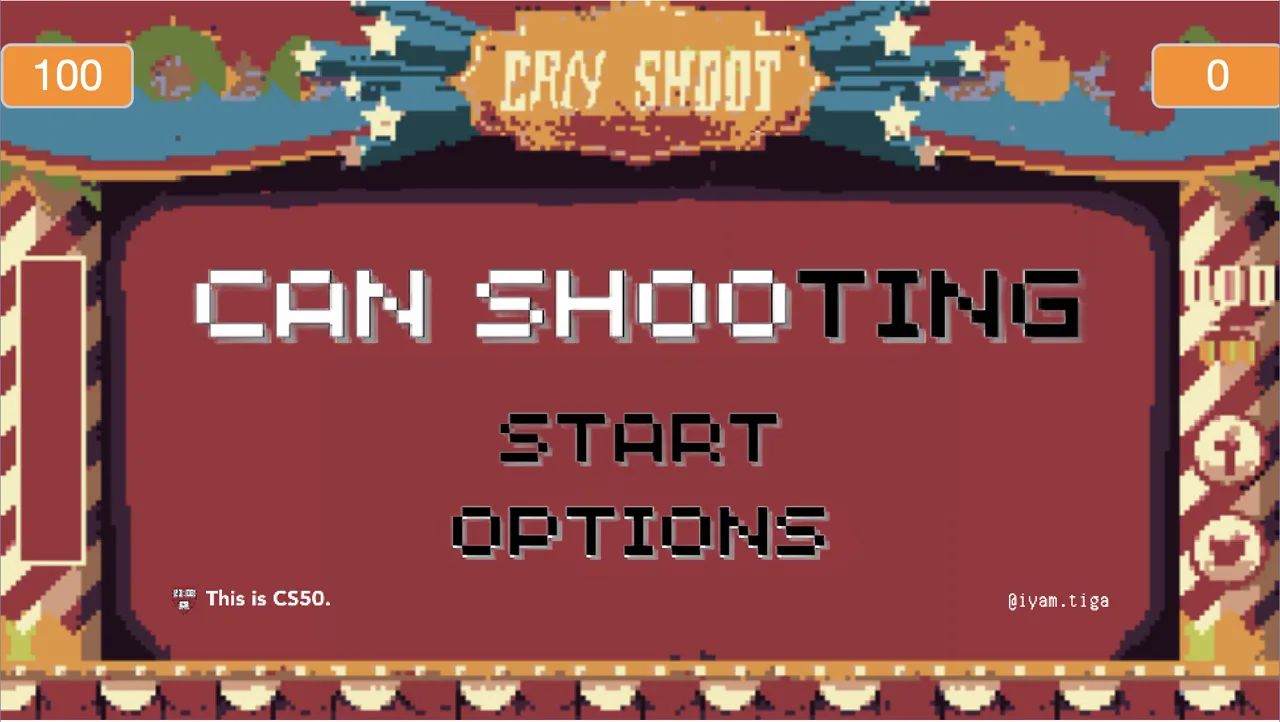
Pixel-art Can Shooting title screen
rare◆ productlive

Can Shooting

A Scratch carnival game for teaching

A point-and-click carnival game built in Scratch, with speed stages, hazards, sound, and hundreds of hand-managed animation frames.

role
Game creator and teacher
org
Independent education project
when
2024 - 2026

What it is

Can Shooting turns a familiar carnival target game into a compact Scratch project used to teach event-driven programming, state, animation, timing, and sound.

Players race a time bar while cans move through slow, medium, and very fast patterns. Special targets and hazards change the score and force quick decisions.

The project is intentionally asset-heavy: sixty-four sprites plus the stage, hundreds of costumes, sound effects, and custom blocks all remain inspectable in Scratch.

where the effort went

  • Teaching94
  • Game feel88
  • Animation96
  • Craft90

the numbers

Sprites + stage
65
Costumes
850
Sounds
26
Custom blocks
26

built with

  • Scratch 3
  • Python
  • SVG
  • WAV
  • Frame animation

delivery record

What I made

I wanted students to see that beginner-friendly blocks can still express a complete game loop with timing, feedback, reusable behavior, and polished animation.

  • 01

    Start, instructions, gameplay, options, and game-over scenes

  • 02

    Three speed stages with moving targets and timed progression

  • 03

    Special cans, hazards, score feedback, and a time bar

  • 04

    Volume controls and twenty-six sound assets

  • 05

    Reusable custom blocks and a large frame-animation pipeline

Hard problems

The constraints mattered as much as the finished interface.

01field note

Animation at Scratch scale

problem
Hundreds of costumes and many moving sprites can become impossible to coordinate with duplicated block stacks.
response
I grouped repeated behavior into custom blocks, kept speed stages explicit, and organized extracted assets alongside the original project.
02field note

Teaching through a finished game

problem
A demo that only teaches syntax does not show how events, state, feedback, and assets work together.
response
The game exposes a complete loop students can play first and then inspect inside Scratch.

Screens

In motion

The opening stage teaches the target rhythm
The final stage compresses the reaction window

after shipping

What stayed with me

  • A playable artifact gives beginners a reason to understand state and events before they know those terms.

  • Visual tools still benefit from the same naming, reuse, and asset discipline as text-based code.